How the Construction of the UP Chapel Paved the Way for Philippine skyscrapers

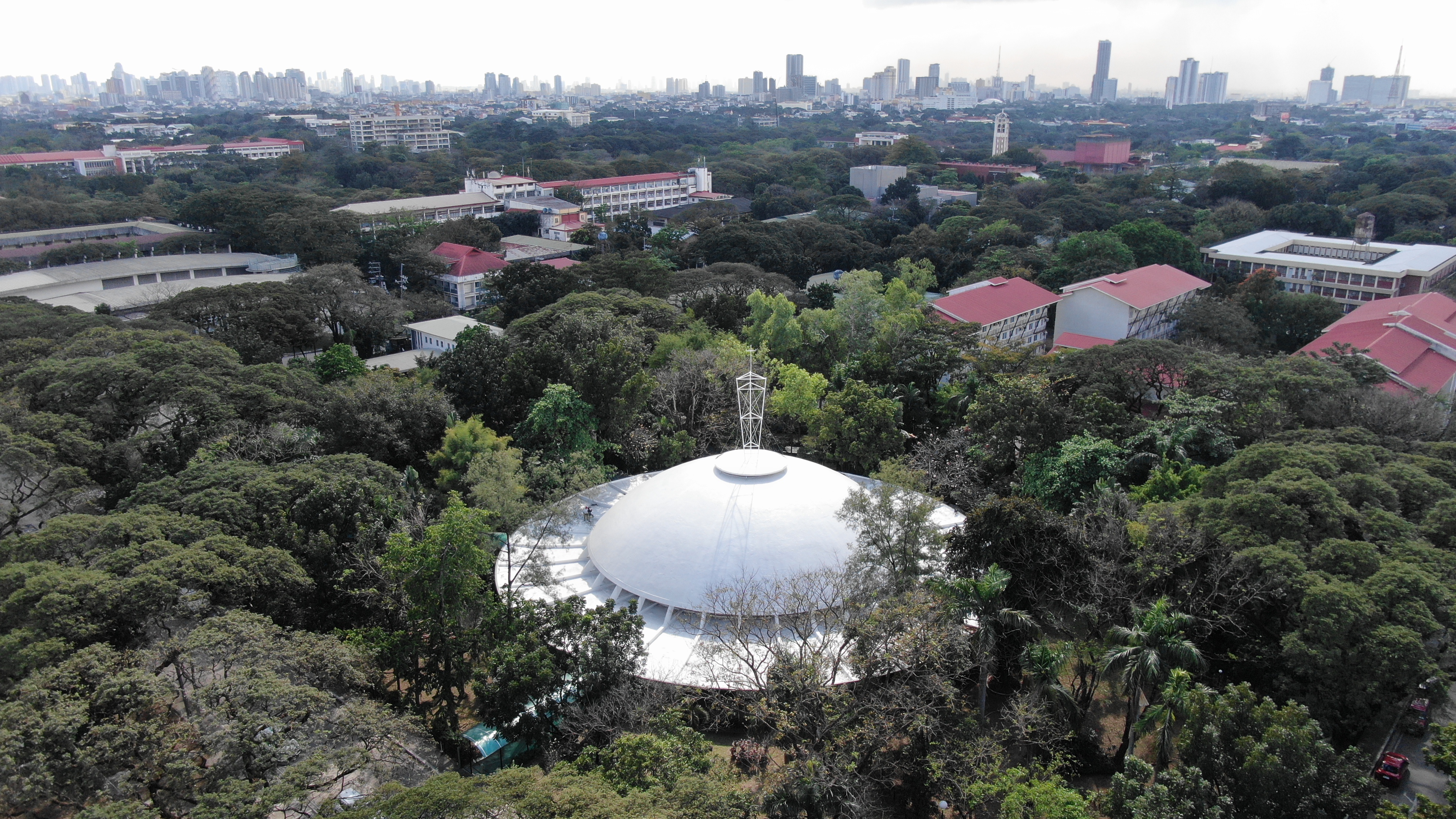
DMCI Homes recently completed the UP Chapel Landscaping Enhancement Project in UP Diliman, Quezon City in time for the church’s 70th anniversary.
As the UP Chapel turns 70 this December 20, 2025, we look back at how its construction contributed to the rise of the Philippines’ own skyscrapers in the words of its builder, Engr. David M. Consunji.
In his memoir A Passion to Build, Engr. Consunji recounted how the UP Chapel, built by his then-startup construction firm, DM Consunji, Inc. (DMCI), became the unlikely starting point for the country’s modern skyline. Fr. John P. Delaney, S.J., the first chaplain of the UP Diliman Catholic community and spiritual advisor of the UP Student Catholic Action (UPSCA), initiated and supervised the project.
The Church of the Holy Sacrifice in UP Diliman was unlike anything attempted in the Philippines. It was designed by a young Leandro Locsin, later a National Artist for Architecture, who translated Fr. Delaney’s vision of a circular, open-air church into the chapel’s iconic dome design.
The chapel, engineered by former UP College of Engineering Dean Alfredo L. Juinio, required a structural solution that seemed impossible: a seamless, floating concrete dome supported by slender columns without beams.
To make the design work, Engr. Consunji had to produce 3,000 psi concrete, far beyond the 1,500 psi commonly used and higher than the 2,400 psi employed by a few builders.
“In the mid-1950s, when most Filipino builders were using 1,500 psi concrete, 3,000 psi seemed unthinkable to many. There were a few using 2,400 psi, but in construction, a difference of 600 psi was a great deal. I had always wanted to try for 3,000 psi concrete; it was being done in other countries and I believed that it could be done here as well, in spite of our limitations. That was why I was experimenting with stronger kinds of concrete at around the time Fr. Delaney was trying to build a new UP Chapel. But I needed Fred Juinio to make me do it commercially, in an actual building where 3,000 psi concrete was the only way to make the design succeed.”
“Fred (Juinio) was a truly remarkable structural engineer. I know a number of engineers coming into the industry from the academe with impressive credentials. But in my opinion, he was the leader. He had a brilliant mind capable of great vision, but he also had a practical bent—a combination that is quite rare among engineers. He was both a designer and an innovator. This was evident in the pioneering structural work he did on the first buildings in the new Ayala central business district—the Monterey Apartments, the Elizalde Building (dubbed ‘the six-storey building’), and the 10-storey FGU building. Unfortunately for the construction industry, Fred's heart was really in teaching, and he chose to spend more time in the academe. I invited him many times to join me in my business, but teaching was really his love. He would have been a great builder. The industry would have reached greater heights with him there. Nonetheless, the construction industry had gained much from Fred's more than three decades of teaching through the bright engineers who came from the UP College of Engineering.”
“Very few people know Fred's contribution to the development of concrete in the Philippines. Even before we did the UP Chapel, we had spent a great amount of time discussing how concrete made in the Philippines could be improved. He was quite dissatisfied with the way concrete was being done here. I remember him saying, ‘All engineers know the rule: the less the water, the stronger the concrete. And yet why is the practice here so way off from the theory?’ He would tell me how important it was for the Filipino building industry to come up with 3,000 psi concrete. Not only would the concrete be stronger, it would also be impermeable to water and therefore protect the steel bars within the concrete. It was also cheaper, because it required less cement: eight bags per cubic meter could produce 3,000 psi concrete, whereas ten to eleven bags were used to produce 2,400 psi concrete. He simply could not understand why nobody was doing anything to come up with stronger concrete.”
The UP Chapel’s completion coincided with the earliest stirrings of what would become Makati’s central business district.
“The success of Forbes Park on the perimeter edge of Fort McKinley then led inevitably to the development of the central area of Makati that was earmarked for businesses, just as Joe McMicking had planned. The two-kilometer Ayala Avenue from Highway 54 (now EDSA) to Buendia was completed in 1956.”
At the same time, DMCI had finished the UP Chapel with new expertise and confidence in high-strength concrete.
“With the completion of Ayala Avenue by the end of 1956, the central area of Makati was all set for development. Fortuitously, we in DMCI had also finished the UP Chapel by then and were ready for new projects. We were fortunate to have met Fernando Zobel during the construction of UP Chapel. He must have been quite impressed by our work at the UP Chapel because immediately after its completion, DMCI was doing business with Ayala. Initially, we did small projects-culverts, small bridges, sidewalks, roads, and other similar jobs. There were still no buildings in the area; this was all preparation for executing the Zobels' long-term plan. Ayala commissioned the young Lindy Locsin to design the first buildings that would serve as the models for the other structures that would be built in the business district. In turn, Lindy brought in Fred Juinio to be the structural engineer for the buildings. I, on the other hand, was asked by Fernando to submit a proposal for the building of what was to be the very first structure in the Makati business district: the Monterey Apartments. In the Philippines at that time, our team-Fred, Lindy, and myself —was probably the best equipped for the job of building a high-rise like the Monterey. After all, we were the first to use 3,000 psi concrete and the first to do a thin shell concrete structure.”
“DMCI was also gaining a good reputation in the industry because of the quality and speed of our work. One reason was that while my competitors were doing things manually, we were already using electrical and air equipment on some tasks. It was this kind of patient accumulation of all kinds of advantages and innovations that made DMCI begin to stand out in the construction industry. I had long been preparing for the time that the high rise would come to the Philippines from my reading and my discussions with Fred Juinio, I knew that the high-rise was the next big thing for the local construction industry. That was the reason for my early experiments with concrete. I knew that sooner than later, our old standards had to go, because we could do the high-rise only if we had stronger concrete and better ways of making concrete forms and depositing concrete.”
This relationship led to a historic commission: the Monterey Apartments, a seven-storey residential building on Ayala Avenue, completed in 1959.
“We built the Monterey in 1959, four years after we first used the 3,000-psi concrete in building the UP Chapel.”
High-strength concrete shaped the building from foundation to roof deck.
“Without that kind of high-strength concrete, we would not have constructed the seven-storey Monterey the way we did. It made the entire Philippine construction industry undergo tremendous changes by opening up a world of new possibilities to architects and builders. It removed the old limits on the height of a building, made new structural and architectural forms possible, and set a new standard for the entire industry.”
The Monterey’s flat slabs, slimmer columns, and three-meter cantilever balconies showcased modern construction on the emerging Makati plain.
Around this time, DMCI also built the Philippines’ first modern skyscraper, the 12-storey Picache Building, now F&C Tower, in front of Plaza Miranda in Quiapo in 1960. Designed by architect Angel Nakpil, it demonstrated the same concrete innovations first proven at the UP Chapel.
Decades later, in 1988, Engr. Consunji witnessed Monterey's demolition.
“One day in 1988, I watched the workers tear down the seven-storey Monterey Apartments… but now it was coming down so that we could build a 43-storey building, the Pacific Plaza, in its place… From where I stood, I could see the many modern buildings lining Ayala Avenue. But as I watched the Monterey being demolished, my thoughts went back to the time when it was newly built… standing all alone on the vast empty plain that was to be Makati's business district.”
The skyscrapers that followed along Ayala Avenue traced their lineage to the daring first proven at the UP Chapel.
“The innovations we used for the one-storey UP Chapel made possible the creation of dozens of skyscrapers along Ayala Avenue over the next four decades and in time the building of a new skyscraper to replace the Monterey.”
Engr. Consunji later marveled at how far concrete technology had advanced.
“These days, with new technology, we can do 10,000 psi concrete in this country without great difficulty. In 1998, Filipino contractors used it for the first time when the Pacific Plaza Towers was built in Fort Bonifacio.”
Seventy years later, the UP Chapel remains a sanctuary of faith and architectural clarity. Its deeper legacy can be seen in the many high-rise projects that came after, shaped by the same construction principles first tested during its build. In Engr. Consunji’s words, it was the innovation that helped make Makati and the modern Philippine skyline possible.
Source: A Passion to Build: A Memoir of David M. Consunji
How do you feel about it?